Tag: history

Soil as a Space Between Life, Death, and Memory

Artist’s Death Abroad. Is It Time for Fame? (self-portrait, diptych)_oil and water-based exterior wood paint on transparent jute and linen canvas_ 200x130cm_ September 2026_Dungarvan_Ireland


This work began with a simple, slightly ironic thought: the idea that an artist becomes famous after death. I painted myself as a body being absorbed into the earth and initially approached the image almost as a dark joke — asking myself what happens to the artist once the work, rather than the person, remains.

As I worked on the painting, however, the image became increasingly personal. I live and work away from the place where I was born, and the body in the painting began to represent something beyond death. It became an image of displacement, of being separated from one’s original roots, and of wondering whether another place can eventually become home.

The body is shown embedded within layers of earth, surrounded by fossils, skeletal remains and traces of other forms of life. Rather than depicting burial simply as a final moment, I am interested in the process through which the body becomes absorbed into the landscape. The distinction between the body and the earth gradually disappears. The human body becomes another physical trace within the history of a place.

The painting is made on a transparent jute canvas, prepared using traditional, time-honoured methods. The choice of material is an important part of the work rather than simply a technical decision. Jute is a natural, tactile material with a strong connection to the earth and to traditional forms of making and manual labour. Its open structure allows the painting to remain connected to the space beyond its surface. The canvas becomes less like a closed boundary and more like a permeable layer between the body, the earth and the surrounding environment.

This material quality is particularly important to my thinking about belonging. The body in the painting is not completely separated from its surroundings. It exists within the same material world as the fossils, soil and landscape. The transparency of the jute reinforces this sense of permeability — of something that can be seen through, passed through and gradually absorbed.

The traditional process of making the jute canvas introduces another layer of time into the work. The material itself carries a history of human making, while the fossils refer to forms of life that existed long before me. My painted body represents the present — a temporary human existence placed between these different scales of time. The work therefore brings together personal time, human history and geological time.

The fossils are particularly important to this idea. They are physical traces of lives that existed before me and have become part of the geological history of the earth. By placing them around my own body, I create a connection between individual mortality and a much larger geological understanding of time. My body becomes another trace — another layer within the history of the earth.

This led me to think about burial not simply as an ending, but as a form of belonging. If the body eventually becomes part of the soil, then perhaps the place where we die can become part of who we are. This raises a question that is personal to me as someone living and working away from the place where I was born:

Can the land where I die become my land?

Can a place that was not the land of my birth become a new root?

This work reflects the wider concerns of my artistic practice. Through painting and self-portraiture, I explore earth, displacement, memory, death and belonging. I am interested in the moment when the body stops being understood only as an individual body and becomes part of the history of a place. I am also interested in whether belonging can be created through time, presence and physical connection rather than only through birthplace or ancestry.


Continue Reading

The Identity of Places: Salvation Game TUAM
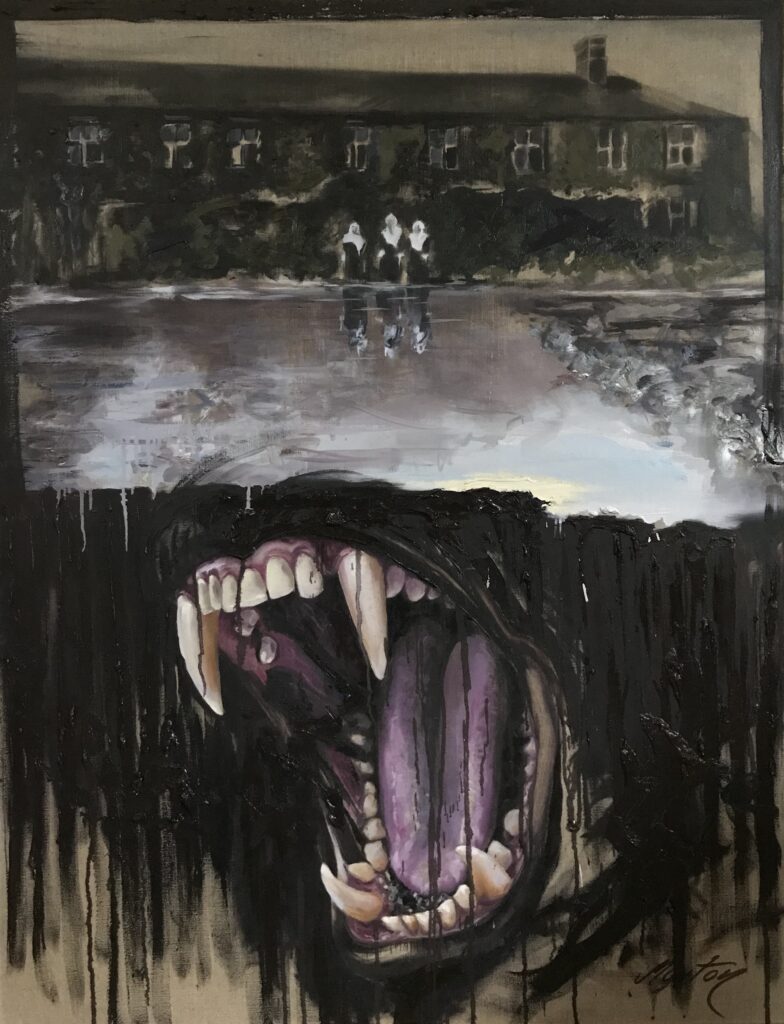
Marcin Paprota Marton_The Identity of Places Salvation Game TUAM_130x100cm_

oil on transparent linen canvas_Dungarvan_Ireland_2025

Landscapes stand as silent witnesses to human history.

“On July 14, 2025, Ireland began the exhumation of 796 children’s bodies from a religious house in Tuam. This place was one of eighteen similar facilities across Ireland where women who became pregnant outside of marriage were sent, often against their will, to give birth away from public scrutiny.

For decades, the tragic fate of hundreds of children who died there remained hidden beneath an unremarkable patch of grass.

The discovery is particularly disturbing because no burial documents, headstones, or any memorials have survived for the estimated 800 children buried there. These children, who died from various causes including malnutrition, neglect, and disease, were laid to rest without minimal ceremony or acknowledgment.

The investigation revealed several troubling aspects of how these institutions operated:

– children were routinely separated from their mothers;

– many infants were given up for adoption, often to families abroad;

– death rates were significantly higher than in the general population;

– record-keeping was intentionally obscured or neglected;

– survivors and families were denied information for decades.

DNA analysis will be conducted where possible to identify remains, potentially allowing families to provide proper burials for relatives they never had the chance to know.

By literally unearthing this painful history, Ireland continues its journey toward reconciliation with its past.” (Text by Clara Byrne: https://newsday.ie/ireland-begins-exhumation-796…/)

The painting exemplifies the decline of a church that until recently was outside the law, not only in Ireland but worldwide.


Continue Reading